




















Late Monday night, as torrential rain fell across Ado-Ekiti, Ibrahim Mandella made a decision that cost him his life. Two days later, one of Nigeria’s largest newspapers published an editorial asking the exact question ConservationsNG has been tracking for three weeks: why do detailed, dated flood warnings keep failing to prevent exactly this outcome?
A death inside the warning window
Mandella, a 35-year-old native of Zuru Local Government Area, Kebbi State, was working near Ijero when heavy rain began falling across the Ekiti State capital on Monday night. He stopped at a car wash in the Adehun area to wait out the downpour. His wife, Favour Mary, called him twice around 10:45pm, urging him to come home; he told her he would be back shortly, and sent N4,500 for dinner before she went to bed with their two children. He never returned. Attempting to cross fast-moving water beneath a narrow bridge, Mandella told those nearby he could make it across. He was swept away. His body was later found near the Mountain of Fire and Miracles Ministries junction in Adehun. His brother, Dauda Daniel, confirmed the account to reporters.
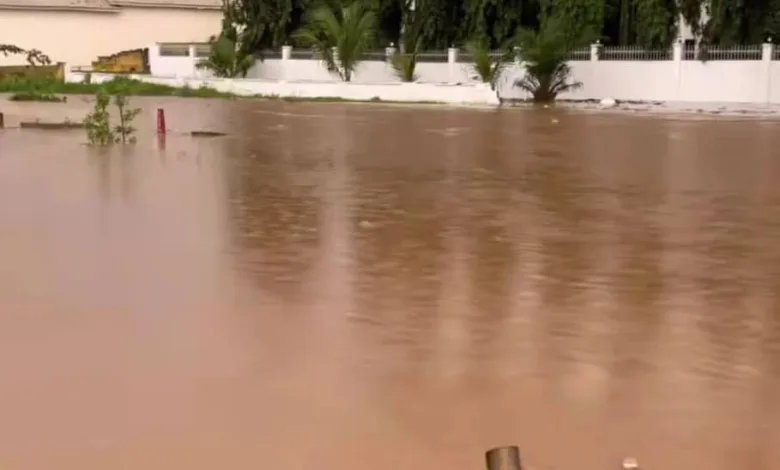
Mandella’s was not the only reported casualty that night. Two commercial motorcyclists were separately swept away at Elemi River, while local reports described an elderly woman and another woman being carried into a drainage canal in the Olorunda area, where a second bridge was said to be nearing collapse entirely. Four other people swept up in the floodwaters were rescued. A bridge along Afao Road caved in during the flooding. Reports on the total death toll have varied, with some placing it at three feared dead; the state government has maintained that no lives were lost, a discrepancy that has drawn criticism from residents and commentators. Areas across the city, including Aayemi Garage, Ureje, Odo-Ado, Faglo, Poly Road and New Iyin Road, were affected. Tosin Aluko-Ajisafe, Ekiti State’s Commissioner for Environment, urged residents to prioritise their safety during heavy rainfall.
The flooding was not confined to Ekiti. The same night, hours of downpour left a trail of damage in Akure, the Ondo State capital, where flooding, erosion and blocked drainage channels affected the metropolis and commercial motorcyclists narrowly escaped as their bikes were swept away.
This flood fell squarely inside a national alert
Mandella’s death did not occur in an information vacuum. It fell within the window of the Federal Government’s 24-state flood advisory, issued on September 29 and covering September 27 to October 10, which named Ekiti among the at-risk states. It also followed months of repeated warnings from the Nigerian Meteorological Agency (NiMet) urging residents of coastal and southern states to prepare for heightened flash-flood risk amid forecasts of sustained, widespread rainfall.
A national newspaper makes the accountability case
On Wednesday, ThisDay published an editorial, “Yet Another Flood Warning,” that echoes the argument this publication has made since our 10 September analysis of Nigeria’s flood early-warning system. The editorial states plainly that authorities responsible for mitigating flood impact “seem to have no actionable plans” for Nigerians at risk, despite the repeated, detailed advisories. It notes that on 25 June, Vice President Kashim Shettima had directed a shift from reactive response to proactive preparedness, stating the government’s approach left “no room for ambiguity in combating flood and other climate-related disasters.” Three months on, the editorial argues, that directive has not translated into visible change on the ground.
The editorial also points to a structural driver behind the rising toll: Nigeria’s urbanisation rate, estimated at 5.5% annually and among the highest in the world, is rapidly expanding the number of people living in flood-vulnerable areas, often in informal settlements along waterways and floodplains, faster than drainage and flood-control infrastructure can keep pace.
A precedent Ekiti has not followed
Separately, commentary published this week draws a comparison Ekiti’s own history suggests it should have absorbed already. Writing in response to the flooding, columnist Michael Ale noted that Ibadan’s catastrophic August 26, 2011 flood, which killed more than 100 people, prompted the creation of the Ibadan Urban Flood Management Project (IUFMP), a World Bank-assisted institutional framework backed by a $200 million commitment. Ale argues that Ekiti’s recurring floods, like Ibadan’s before reform, stem not from unpredictable weather but from known, mapped causes: building on waterways, blocked drains, absent pre-season dredging and refuse accumulation in canals, and that the solution lies in building comparable institutional capacity rather than waiting for individual leaders to act.
What Ekiti adds to the pattern
Mandella’s death adds a specific, named human cost to a pattern this publication has now documented across Ebonyi, Edo and now Ekiti: detailed, accurate warnings issued well in advance, followed by localised disasters that the warning’s own window anticipated, followed by a gap between what officials say happened and what residents and families report. With NEMA’s own count already at 259 deaths nationally before this week’s toll is added, and the 24-state alert continuing through October 10, the question ThisDay’s editorial and Mandella’s family are, in different registers, both asking is the same one: what, specifically, changes between one flood warning and the next.