










One country’s highest point is five metres above sea level. Another has already abandoned entire villages to saltwater. A third could see its capital city 40% underwater within a century. These are not hypothetical futures — they are current trajectories, backed by NASA, the World Bank and the UN itself.
On September 24, the UN General Assembly took action on the legal side of that threat, even if it can’t yet stop the water. It adopted the world’s first Declaration on Sea Level Rise, guaranteeing that these ten countries, and dozens like them, keep their statehood, sovereignty and UN seat no matter how much land they lose. Here’s who the declaration was written for, and just how close to the edge each of them already is.
Read also: What the UN’s New Sea-Level Rise Declaration Means for West Africa’s Eroding Coast
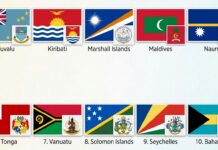
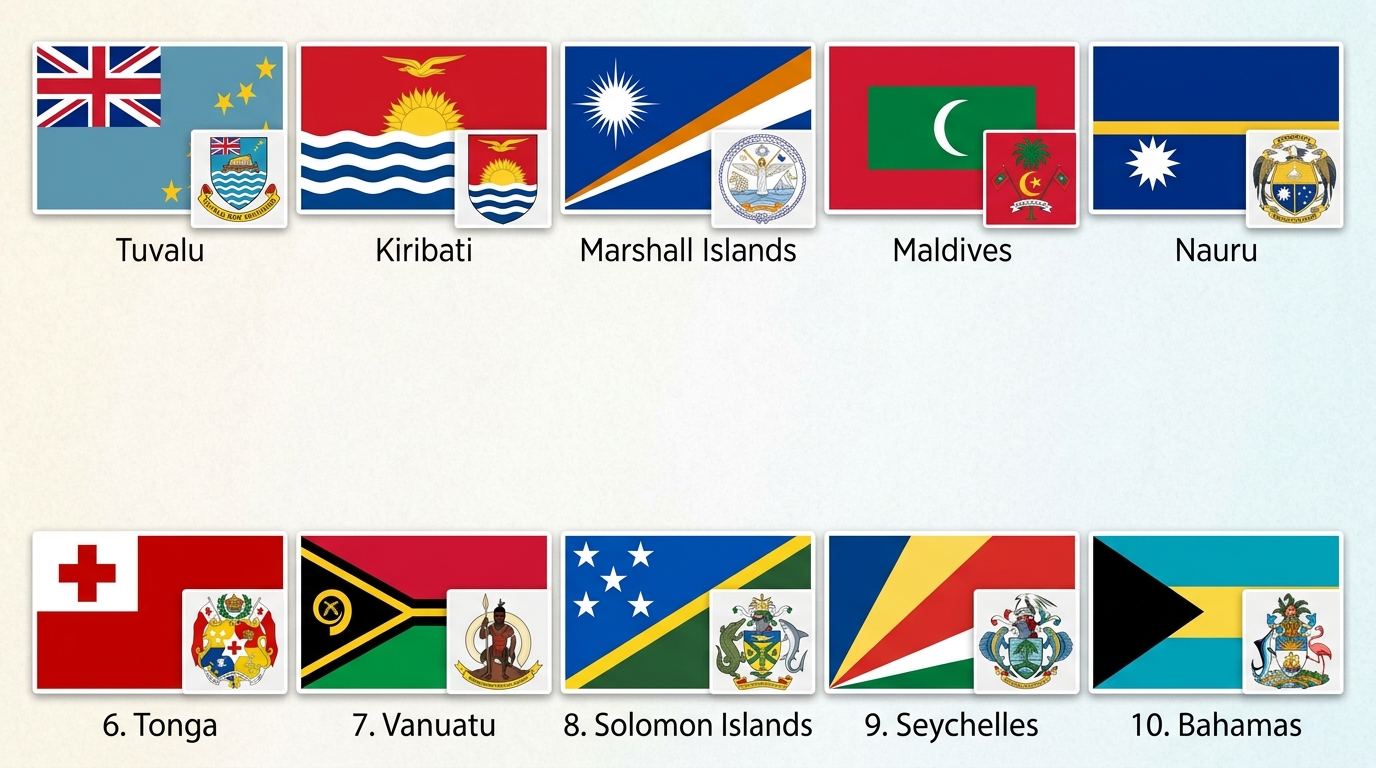
1. Tuvalu — the country racing the tide
Highest point: five metres above sea level. Sea-level rise over 30 years: 21 centimetres, nearly double the global average. By 2050, NASA projects daily tides could submerge half of Funafuti, the atoll home to 60% of Tuvalu’s population. Tuvalu didn’t wait for the UN: it already signed a bilateral treaty with Australia guaranteeing its statehood regardless of what happens to its land. The new declaration takes that idea global.
2. Kiribati — a nation the size of a small park, scattered across an ocean
Thirty-three atolls. Total land area: roughly 800 square kilometres, smaller than Exmoor National Park, spread across 3 million square kilometres of Pacific Ocean. Average elevation: three metres. Local seas are rising four times faster than the global average, and the village of Tebunginako has already been abandoned to advancing salt water.
3. Marshall Islands — 40% of a capital city, underwater
A one-metre sea-level rise, a scenario now well within scientific projection ranges, could permanently inundate 40% of the buildings in Majuro, the capital, according to a joint study by the Marshall Islands government and the World Bank. Sixty thousand people call these five islands and 29 atolls home.
4. Maldives — the lowest country on Earth
Average elevation: 1.5 metres. Highest point anywhere in the country: 2.3 metres. It’s the lowest nation on the planet, full stop. Under a 90-centimetre sea-level rise scenario, up to 85% of the capital, Malé, could be submerged.
5. Nauru — 21 square kilometres, nowhere to retreat to
One of the smallest nations on Earth has nowhere higher to move its population. Nauru has been one of the loudest Pacific voices demanding exactly the kind of statehood guarantee this declaration now provides.
6. Tonga — rising seas meet rising storms
More than 170 islands, low-lying and increasingly caught between two escalating threats at once: sea-level rise and intensifying cyclones. The combination has kept Tonga near the top of every UN Pacific vulnerability assessment for years.
7. Vanuatu — officially the world’s most disaster-prone country
The UN’s own ranking. Vanuatu combines sea-level rise with the highest rate of cyclone formation in the region, and a 2023 study found it has the highest expected annual population exposure to coastal flooding, as a share of population, of any small island developing state on Earth.
8. Solomon Islands — the islands that are already disappearing
Not a future risk: several small islands within the Solomons archipelago have already eroded away entirely or shrunk dramatically, according to peer-reviewed coastal research. Stilted housing is now standard construction across exposed coastal villages.
9. Seychelles — losing land ten times faster than expected
Sea levels here have risen roughly seven inches in a century, about ten times the pace recorded in the most recent decade alone. With 85% of economic activity clustered along the coast, this is as much an economic emergency as a territorial one.
10. Bahamas — flooding from below, not just above
Limestone geology means seawater can seep upward through the ground itself, flooding communities without a single wave reaching the shore. New Providence Island, the country’s most populous, sits squarely in the danger zone.
The line that matters most
Every nation on this list faces a version of the same terrifying question: what happens to a country when its land is gone? On 24 September, the UN answered it. As Surangel Whipps Jr, President of Palau and Chair of the Alliance of Small Island States, put it: “Our zones are stable. Our statehood continues. Sea level rise threatens our coasts, our homes and our ways of life. It does not threaten our legal rights or our standing as states.”
Read also: On World Rivers Day, Nigeria Confronts Fragmented Approach to Watershed Protection
The water is still rising. But for the first time, the map these ten countries hold on the world stage isn’t rising or falling with it.