


















A week ago, this ConservationsNG asked whether Nigeria’s flood forecasting apparatus was translating detailed warnings into action, or repeating a familiar cycle of accurate predictions followed by inadequate response. That question is no longer hypothetical. On Saturday, the Nigeria Hydrological Services Agency (NIHSA) issued Flood Alert NFA-2026-262, warning of a high risk of riverine flooding across 15 states between September 19 and 25 — and the country’s emergency response machinery is now being tested in real time.
The alert, in detail
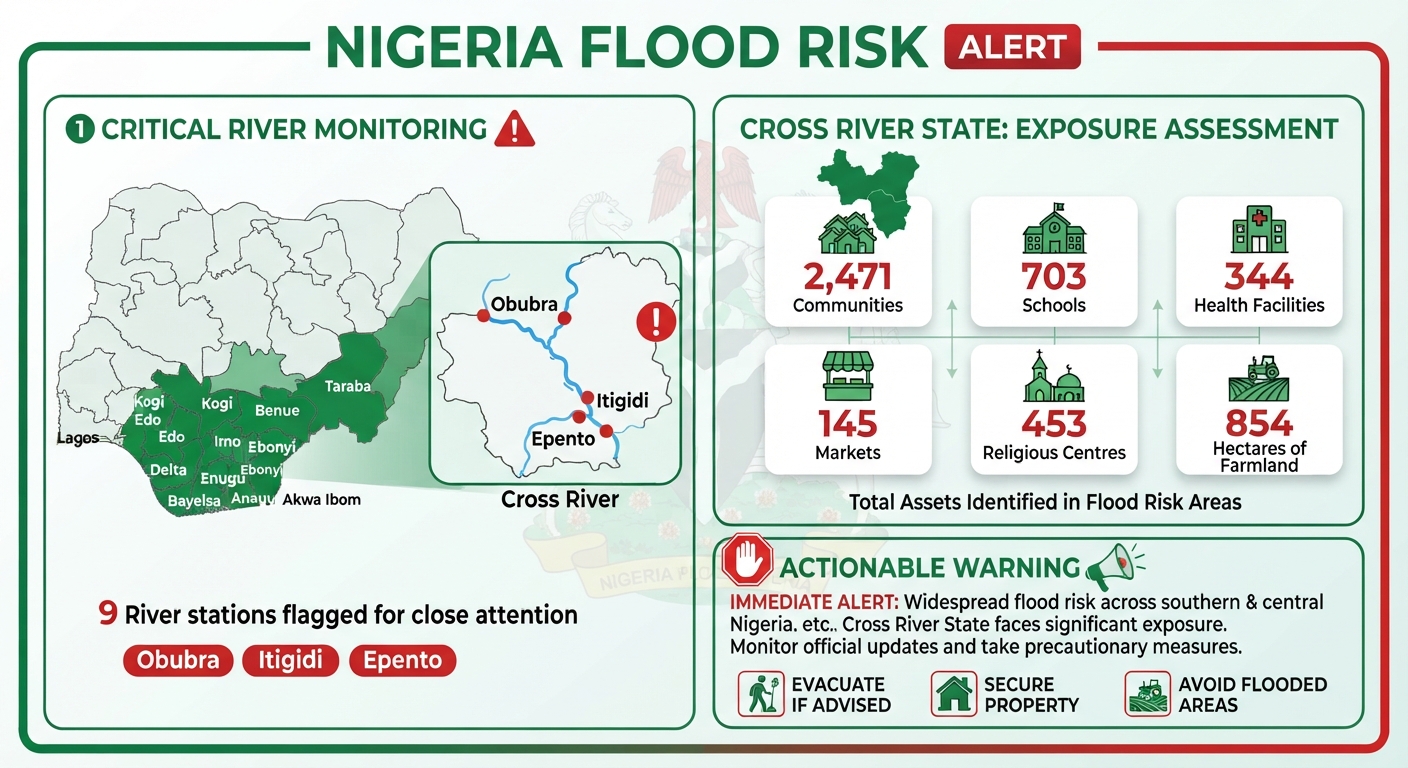
Umar Ibrahim Mohammed, Director-General and Chief Executive Officer of NIHSA, said the alert followed forecasts of rising river levels across vulnerable areas. Nine river monitoring stations were flagged as requiring close attention, including Obubra, Itigidi and Epento on the Cross River. The states named span much of southern and central Nigeria: Imo, Cross River, Ebonyi, Benue, Anambra, Akwa Ibom, Lagos, Rivers, Edo, Kogi, Taraba, Delta, Bayelsa, Enugu and Abia.
The scale of exposure in a single state illustrates the stakes. In Cross River State alone, NIHSA’s assessment identified 2,471 communities, 703 schools, 344 health facilities, 145 markets, 453 religious centres and 854 hectares of farmland within flood exposure areas. Mohammed urged state governments, local government councils, emergency management authorities, traditional and community leaders, and residents in vulnerable areas to take immediate steps to protect lives, property and livelihoods, including relocating people, livestock and valuables from floodplains to higher ground, activating community-based early-warning systems, and clearing blocked drainage channels where it is safe to do so.
NEMA’s response mechanism activates
Following the advisory, Zubaida Umar, Director-General of the National Emergency Management Agency (NEMA), activated the agency’s zonal directorates and operations offices across all 15 affected states. She directed them to immediately activate existing preparedness mechanisms, intensify monitoring of vulnerable communities, maintain close coordination with state and local authorities, and remain on standby to deploy assistance where necessary.
Umar urged residents living on floodplains, riverbanks and other low-lying, flood-prone locations to take the warning seriously and relocate to identified safe, higher ground before conditions deteriorate. She specifically called for protective measures for children, older persons, pregnant women and persons with disabilities during evacuation. State and local government authorities were also directed to pre-position relief materials, including food, non-food items, safe drinking water, water-treatment supplies and first-aid materials, at strategic locations on higher ground.
Why this is the test our earlier reporting anticipated
This alert arrives precisely where our 10 September analysis of NIHSA’s 2026 Annual Flood Outlook left off. That piece drew on international case studies to argue that a forecast, however precise, only saves lives if paired with community-level communication, pre-positioned evacuation infrastructure and public trust built before the water rises. Bangladesh’s Cyclone Preparedness Programme succeeded because it invested for decades in exactly that “last mile.” Libya’s Derna dam collapse and Germany’s Ahr Valley floods, by contrast, both demonstrated how warnings, however sophisticated, can fail to reach or move the people they are meant to protect.
Read also:How Decades of Drought, Deforestation, and Policy Gaps Fuelled West Africa’s Climate Crisis
NFA-2026-262 gives Nigeria’s institutions a concrete, dated opportunity to show which pattern they follow. NIHSA has done its part: the alert names specific rivers, specific states and a specific seven-day window, with granular exposure data down to the number of schools and health facilities at risk in a single state. NEMA has activated its response architecture on paper. What remains unverified, and will only be confirmed over the coming week, is whether that activation reaches the 2,471 communities named in Cross River State alone, and the equivalent numbers across the other 14 states, in time to matter.
What to watch this week
Three questions from our earlier reporting apply directly here. First, does the warning reach affected communities through channels they actually use, not just official press statements? Second, are evacuation shelters and relief materials genuinely pre-positioned, or does that language remain aspirational once floodwaters rise? Third, when the alert window closes on 25 September, will there be a public accounting of what worked and what did not, or will the cycle simply repeat with the next advisory?
ConservationsNG will be following developments in the affected states over the coming days.