



















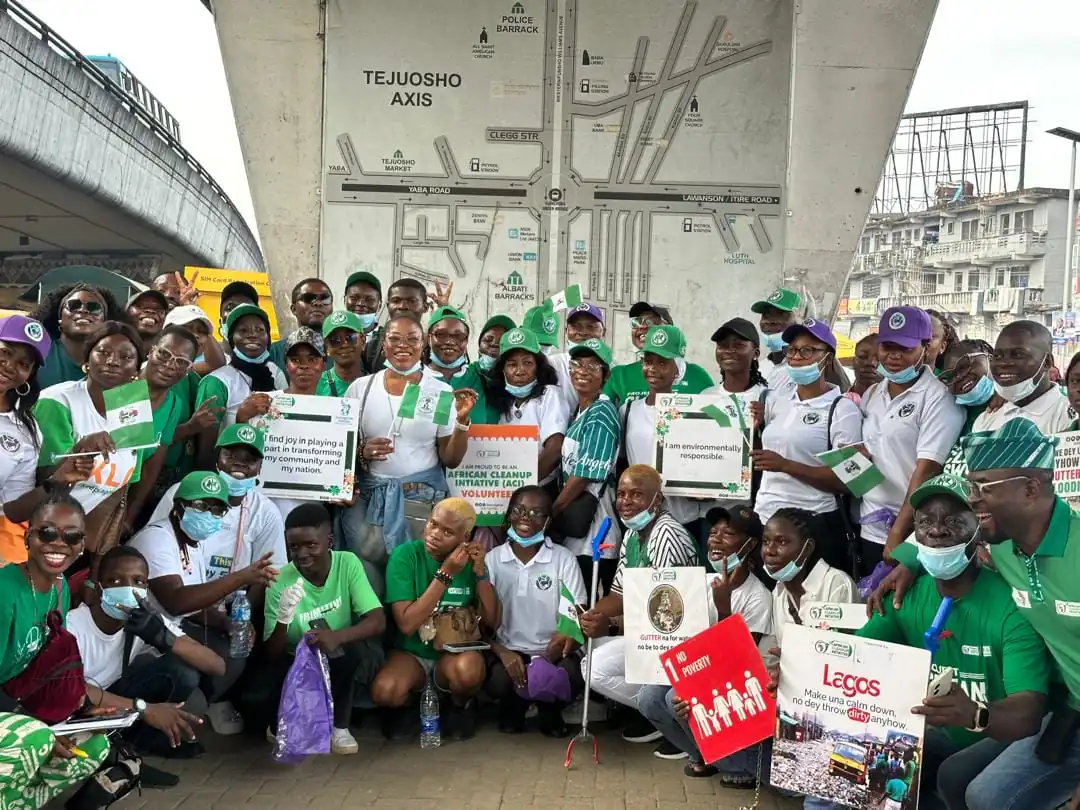
On Saturday, as Nigeria marked its 66th Independence anniversary, thousands of volunteers across multiple states and the Federal Capital Territory picked up gloves and bin bags for a different kind of national celebration: the country’s first-ever Nigeria Cleanup Day.
A nationwide mobilisation, built on local partnerships
The inaugural Nigeria Cleanup Day 2026 was organised by the African Cleanup Initiative (ACI) in partnership with the United Nations Information Centre, Abuja. Volunteers cleaned streets, communities, schools, markets and other public spaces nationwide, while parallel activities promoted recycling, environmental education and climate awareness. In Abuja, Zainab Mohammed, Co-Convener of Nigeria Cleanup Day, joined the exercise at Kuje Local Council, reaffirming her commitment to advancing sustainable development through collaboration among citizens, communities, civil society, government and other stakeholders.
90-Day-Old Oil Spill, Disputed Date: Inside The Azuzuama Deadlock
In Lagos, the day’s activities were anchored by an Advocacy Walk for Recycling and the Environment (AWARE), running from Ojuelegba Underbridge to Teslim Balogun Stadium. Alexander Akhigbe, President of the African Cleanup Initiative and Convener of Nigeria Cleanup Day, used the walk to frame the initiative’s underlying philosophy. “The cleanup was the action, but community ownership is the vision,” he said, adding that the goal was to build a culture in which citizens take responsibility for their environment without waiting for government or outside organisations to act.
A deliberate choice: citizens first, not aid dependency
What distinguishes Nigeria Cleanup Day from a standard civic clean-up exercise, organisers say, is its explicit aim to outlast the day itself. Akhigbe said the initiative was ultimately designed to create “everyday custodians of the environment” across the country, rather than a once-a-year photo opportunity. Organisers said the impact of the day should be measured by what continues afterward, not simply by the volume of waste collected on Saturday.
That framing reflects ACI’s broader track record. Founded in 2010, the organisation has spent 16 years running environmental clean-up, education and advocacy programmes across all six of Nigeria’s geopolitical zones, through projects including Cleanup Naija, the Lagos Cleanup Challenge, and a Recycling Empowerment and Advocacy Project aimed at children. The organisation has also built partnerships with corporate sponsors, including Coca-Cola, Nestlé, Wema Bank and Oando, and recently partnered with Fidson Healthcare on a separate Lagos clean-up tied to World Cleanup Day, which saw the Lagos Waste Management Authority’s advocacy team join volunteers in Obanikoro, Fadeyi, Palmgrove and Shomolu.
Why timing and scale matter
Choosing Nigeria’s Independence Day for the inaugural event was a deliberate pairing of civic pride with civic responsibility, linking environmental stewardship to national identity rather than treating it as a separate, niche concern. The approach also reflects a wider pattern in ACI’s work. Rather than operating as a standalone campaigner, the organisation has increasingly positioned itself as a convening partner for state governments, as seen in Ondo State, where the ACI chapter formally partnered with the state’s Ministry of Information and Orientation in July to tackle declining participation in monthly sanitation exercises, blocked drainage and poor waste management practices.
Read also: What Is Article 6 Of The Paris Agreement, And Why Does It Matter For Nigeria?
With the first Nigeria Cleanup Day now complete, the real test, as organisers themselves acknowledge, lies beyond Saturday: whether the volunteers mobilised for a single, symbolically timed day translate into the sustained, everyday behavioural change the initiative says it is ultimately chasing.