


















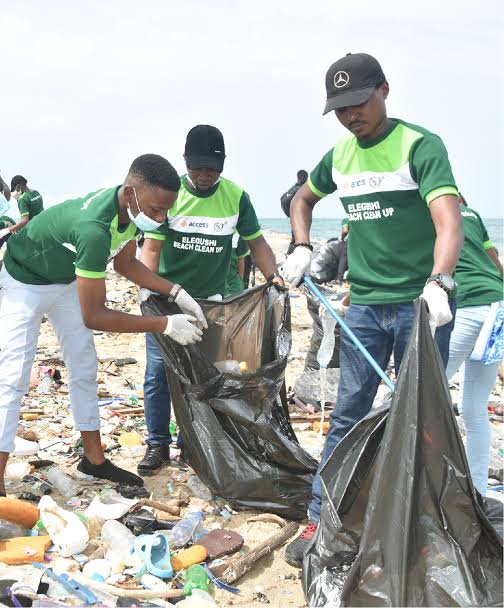
When volunteers turn out for a beach or street clean-up in Lagos and other parts of Nigeria the logistics, branding and funding behind that single day often trace back to one organisation acting as the connective tissue between corporate sustainability budgets and ground-level environmental work: the African Cleanup Initiative (ACI).
The model: ACI as implementing partner, not primary funder
ACI rarely funds its own clean-ups outright. Instead, it positions itself as the “implementing partner,” the organisation with the volunteer networks, community relationships and on-the-ground logistics, while corporate sponsors and foundations provide funding, branding and, often, employee volunteers. Founded in 2010 as a sanitation and advocacy project called Clean Up Nigeria, ACI now operates across all six of Nigeria’s geopolitical zones, with corporate partnerships forming the financial backbone of that reach.
The biggest named partners, and what they’ve actually funded
Coca-Cola has one of the longest-running relationships with ACI, dating back several years to a cleanup at Alpha Beach, Lagos, organised under the Coca-Cola System’s Employee Volunteer Scheme. Nwamaka Onyemelukwe, Director of Public Affairs, Communications and Sustainability at Coca-Cola Nigeria, said the partnership reflected the company’s interest in protecting “cultural landmarks that allow families to come together.” The project was later bolstered by a direct grant from The Coca-Cola Foundation in 2020. More broadly, Coca-Cola’s Nigerian operations sit within its continent-wide World Without Waste programme, through which the company says it has collected more than one billion PET bottles in Nigeria.
Read also: Follow The Money: Where Nigeria’s Projected Carbon Finance Would Actually Go
Sterling Bank, through the Sterling One Foundation, has been ACI’s partner for four to five years, according to Alexander Akhigbe, Founder of ACI, across multiple communities. That relationship culminated in a nationwide beach and street clean-up spanning 17 states, launched at Alpha Beach. Olapeju Ibekwe, Chief Executive Officer of the Sterling One Foundation, pointed to initiatives like Waste Bank, which lets community members trade plastic waste for credits toward school fees and healthcare, as an example of converting recovered plastic into tangible value. Akpore Idenedo, Divisional Head of Commercial Banking at Sterling Bank, said the bank’s involvement reflects its corporate purpose to “enrich lives and protect the environment.” Sterling Bank separately noted that Nigeria generates between two and 2.5 million tonnes of plastic waste annually, with Lagos alone responsible for roughly one million tonnes.
Fidson Healthcare ran a more recent, smaller-scale partnership, Project Clean Sweep 2026, mobilising staff and volunteers to clean the Obanikoro, Fadeyi, Palmgrove and Shomolu areas of Lagos for World Cleanup Day, with the Lagos Waste Management Authority’s advocacy team also taking part.
Named but less documented: ACI’s own website lists Wema Bank, Wecyclers, Betking, Oando, Nestlé and the Ven Foundation among its wider partner roster, though we found no detailed, dated account of what any of these specific partnerships have funded or delivered, beyond their appearance as logos on ACI’s partnerships page.
Government partnerships: a different kind of currency
Not all of ACI’s partnerships involve direct funding. In Ondo State, the organisation’s state chapter secured a formal partnership with the Ministry of Information and Orientation in July, aimed at strengthening public awareness and grassroots advocacy, including local-language media campaigns across the state’s 18 local government areas. Here, the state government’s contribution is less about money and more about publicity, access and institutional legitimacy, which can matter as much as a direct grant when trying to shift public behaviour at scale.
What this funding model means
ACI’s structure reflects a broader pattern across Nigeria’s environmental NGO sector: individual campaigns are often financially underwritten by consumer-facing brands with sustainability targets to meet, particularly beverage and banking companies, while the organisation itself supplies the expertise and community trust that money alone cannot buy. It is a model with an obvious limitation. ACI’s cleanup capacity scales with corporate CSR budgets and partnership renewals, something our earlier reporting raised directly: whether volunteer-driven, sponsor-funded clean-up days can match the structural, year-round demands of Nigeria’s waste management gap.