






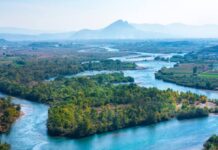






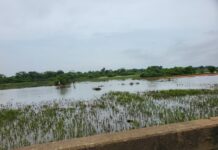

Nigeria Hydrological Services Agency (NIHSA) Director General, Umar Ibrahim Mohammed, has issued an urgent high-risk flood alert for 15 states across the federation. The alert, designated NFA-2026-262, warns that rapidly rising river levels could trigger catastrophic riverine flooding.
Read also: 14,000 Communities Were Warned. Is Nigeria Listening?
Nine major river stations are undergoing critical monitoring. In Cross River State, hydrological stations at Obubra, Itigidi, and Epento face severe exposure. State-level assessments indicate that 2,471 communities, 703 schools, 344 health facilities, and 854 hectares of farmland sit directly in the flood pathway. Aside from Cross River and Lagos, the alert covers Imo, Ebonyi, Benue, Anambra, Akwa Ibom, Rivers, Edo, Kogi, Taraba, Delta, Bayelsa, Enugu, and Abia.
Rising Waters Strain Natural Buffers and Urban Drainage Systems
The national alert urges emergency management agencies and local councils to clear blocked drainage networks and pre-position relief supplies immediately. Residents living along low-lying floodplains have been advised to relocate livestock, family members, and essential valuables to higher ground.
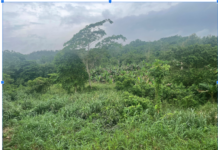
Environmental experts highlight that deforestation and habitat degradation have stripped away the country’s natural ecological buffers. Without dense root systems and intact wetlands to absorb heavy seasonal downpours, surface runoff flows unchecked into major river basins, accelerating soil erosion and inundating vulnerable settlements.
ECOWAS Parliament Calls for Action on Climate Displacement
The flood alert coincides with the opening of the ECOWAS Parliament’s 2026 Second Extraordinary Session Seminar in Accra, Ghana. Speaker of the ECOWAS Parliament, Mémounatou Ibrahima, addressed regional lawmakers on the escalating human cost of environmental disruption.
Read also: Wetlands or Estates? The Land-Use Trade-Off Fuelling Nigeria’s Floods
Speaker Ibrahima emphasised that climate disruption can no longer be evaluated through scientific statistics or abstract projections alone. She noted that degraded farmland, retreating coastlines, and inundated neighbourhoods are driving forced migration and economic instability across West Africa. Parliamentarians are urging member states to move beyond formal declarations and implement practical, cross-border resilience mechanisms to protect populations whose habitats are changing faster than their capacity to adapt.