

















Nine days ago, ConservationsNG asked whether Nigeria’s flood warning system could translate a precise, dated forecast into action before disasterwhether Nigeria’s flood warning system could translate a precise, dated forecast into action before disaster struck. In Ebonyi State, the answer has now played out, and it did not go the way the warning intended. As the floodwaters recede, a new alert covering nearly two-thirds of Nigeria’s states suggests the crisis is accelerating faster than the response designed to meet it.
The warning named Ebonyi specifically
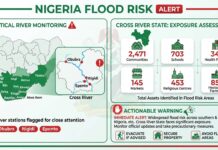
On September 19, the Nigeria Hydrological Services Agency issued National Flood Advisory NFA-2026-262, warning that 15 states faced high riverine flood risk between 19 and 25 September. Ebonyi was named explicitly, with granular exposure data: 2,574 communities, 1,064 schools, 422 healthcare facilities, 480 markets and 1,882 hectares of farmland identified as lying in the flood path. The advisory named specific river monitoring stations and urged state governments to act without delay.
The flood arrived on day five
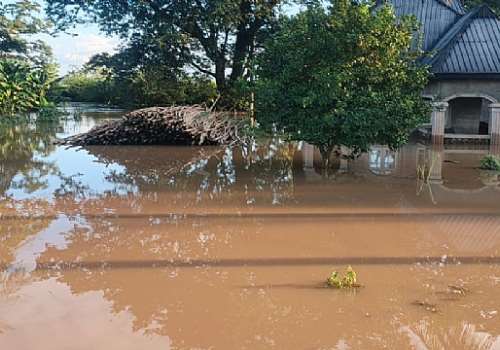
It did. On Wednesday, 23 September, four days into the alert window, torrential rainfall caused a river to overflow its banks in Akaeze community, Ivo Local Government Area. Houses, many of them mud structures, collapsed as floodwaters surrounded them. By the time Premium Times and Vanguard reporters reached the area, 134 families had been affected in Amaegbu alone, with at least 60 houses destroyed and roughly 300 residents displaced. Michael Uzor, a resident, said the flood had destroyed his farmlands, television sets, vehicles and certificates.
The damage was not confined to Ivo. In neighbouring Ohaozara Local Government Area, flash floods swept through a rural hamlet already battling what Channels Television described as systemic neglect, with no motorable access roads, electricity, clean drinking water, telecommunications coverage or basic schools. The community was cut off for days, with residents forced to navigate by canoe. Chinasa Emmanuel, a nursing mother, told Channels she was left with no food, no clean water and no home. Separate reporting recorded eight deaths from the flooding across the affected Ebonyi communities.
Relief arrived before government evacuation orders
In the days immediately following the flood, assistance came first from politicians, not from the coordinated evacuation the original NIHSA advisory had called for. Ifeanyi Odii, the Peoples Democratic Party’s governorship candidate in Ebonyi, donated N5 million on 25 September. The following day, Nkemkama Kama, the federal lawmaker representing Ohaozara, Onicha and Ivo, donated a further N8 million and relief materials alongside Obasi Abara, the state’s Commissioner for Infrastructure.
Read also: High Flood Risk Threatens Lagos, Cross River, 13 Other States as ECOWAS Parliament Demands Regional Action
It was not until September 28, five days after the flood struck and three days after the original alert window had closed, that Francis Nwifuru, Governor of Ebonyi State, directed the State Emergency Management Agency to evacuate and relocate residents in Ivo and Ohaozara, and to coordinate with the National Emergency Management Agency for federal support. Nwifuru also warned residents against returning prematurely to flood-prone or structurally compromised buildings.
The risk zone is now widening, not narrowing
Rather than closing, Nigeria’s flood emergency has expanded. On September 29, the Federal Government issued a fresh advisory placing 24 states and the Federal Capital Territory on a critical flood-risk list for September 27 to 10 October, nearly triple the geographic scope of the alert three weeks earlier. The new list spans the Niger Delta, North Central, South East and parts of the North, including Delta, Bayelsa, Rivers, Edo, Akwa Ibom, Cross River, Abia, Imo, Ondo, Benue, Kogi, Kwara, Niger, Adamawa, Bauchi, Taraba, Anambra, Ebonyi, Enugu, Ekiti, Lagos, Ogun, Osun and Oyo, with parts of Abuja itself classified High Risk. Usman Abdullahi Bokani, Director of the ministry’s Erosion, Flood and Coastal Zone Management Department, signed the advisory, again urging residents to follow evacuation instructions and avoid floodwater. Separately, NIHSA has raised a further flood alarm covering 17 states.
Elsewhere, the human and ecological toll continues to mount. In Enwan community, Akoko-Edo Local Government Area of Edo State, flooding on September 28, killed 1,400 birds at a poultry farm and destroyed a palm oil mill. Monday John, the farm’s owner, said the flood had taken over his premises and destroyed his major source of livelihood.
What the Ebonyi situation demonstrates
Ebonyi’s flood offers a concrete answer to the question this publication raised on 22 September: does Nigeria’s warning system reach communities through channels they actually use, in time to matter? In Ohaozara, a community already lacking roads, electricity and telecommunications, the answer appears to be no; isolation that predates the flood likely limited how effectively any warning, however precise, could have reached residents at all. And where the warning may have reached local government, the coordinated evacuation response it called for arrived five days after the water did, not before.
Read also: 14,000 Communities Were Warned. Is Nigeria Listening?
With 24 states now under a widened alert running through 10 October, Ebonyi’s experience raises a sharper question for the weeks ahead: whether the lag between forecast and evacuation order narrows, or whether other communities without Ohaozara’s infrastructure gaps face the same five-day delay.