





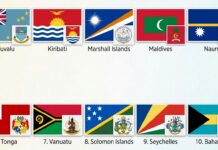



While the world’s attention was fixed on small Pacific and Caribbean island states, the United Nations General Assembly adopted a declaration this week with implications reaching far beyond them, including for a West African coastline that is eroding at rates of several metres a year.
A first-of-its-kind legal commitment
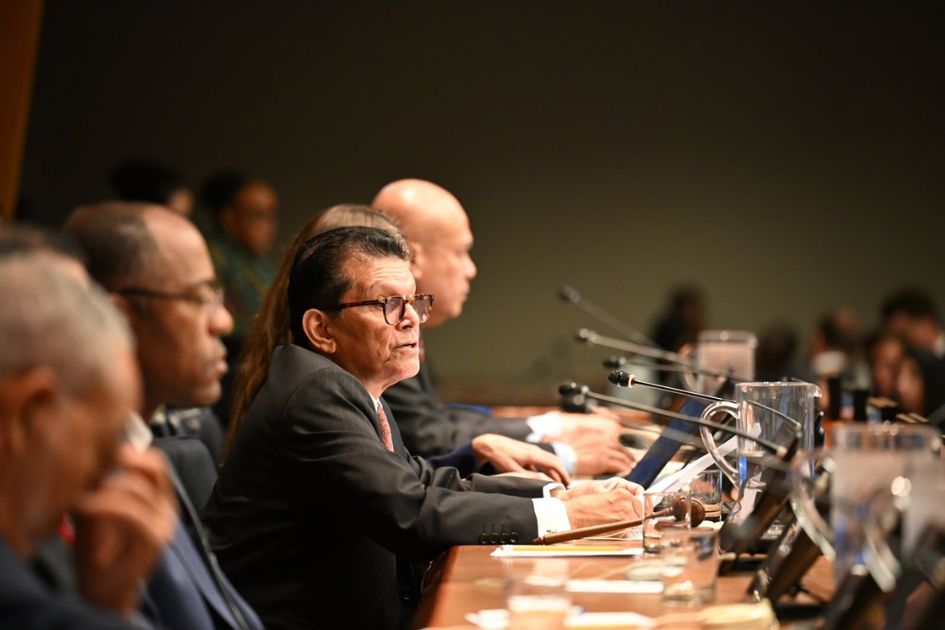
The Declaration on Sea Level Rise was adopted by consensus last Thursday at a high-level meeting alongside the UN General Assembly’s 81st session in New York, marking the first time all UN member states have agreed a common text on the legal and practical implications of rising seas. The four-page declaration affirms that countries threatened by sea-level rise will retain their statehood, sovereignty, maritime zones and UN membership even if parts of their physical territory become submerged, resolving a question that had loomed over small island states for over a decade.
Surangel Whipps Jr, President of Palau and Chair of the Alliance of Small Island States (AOSIS), welcomed the outcome: “Today the General Assembly spoke with one voice. Our zones are stable. Our statehood continues. Sea level rise threatens our coasts, our homes and our ways of life. It does not threaten our legal rights or our standing as states,” he said. António Guterres, UN Secretary-General, framed the stakes in blunter terms, according to the World Meteorological Organization: “Sea-level rise reaches far beyond the environment. It is a threat multiplier, battering economies, trade, infrastructure, and food systems.”
The numbers behind the declaration
The scale the declaration responds to is considerable. According to the UN, roughly 770 million people live in coastal areas less than five metres above the high-tide line. A sea-level rise of just half a metre by 2100, a scenario now considered likely under most climate projections, could displace between 150 million and 300 million people from their homes worldwide. Beyond legal statehood, the declaration commits member states to strengthening early-warning systems, coastal protection infrastructure, disaster risk reduction and climate adaptation finance, and to holding a further high-level review meeting in 2029.
Read also: On World Rivers Day, Nigeria Confronts Fragmented Approach to Watershed Protection
Kamal Amakrane, Managing Director of the UN’s Rising Nations Initiative, said the economic consequences will not be confined to small islands, telling Euronews: “Every centimetre of sea-level rise will be translated in stronger storms, in stronger high tides, will be translated in many economic losses, because the ports will need to be adjusted and adapted. Some of the airports may need to be moved.”
Why this matters for West Africa’s coastline
Although negotiated primarily around the survival of small island states, the declaration’s underlying concerns are strikingly close to home. West Africa’s coast, from Mauritania to Cameroon, is widely documented as one of the most erosion-prone in the world, with shoreline retreat in places reaching several metres annually, driven by a combination of sea-level rise, sand extraction, upstream dam construction, and port development that disrupts natural sediment flow.
Nigeria’s roughly 850-kilometre coastline places millions of people across Lagos, Rivers, Bayelsa, Delta, Akwa Ibom, Cross River and Ondo states in the path of increased tidal flooding, shoreline erosion, saltwater intrusion into rivers and groundwater, and loss of wetlands and mangrove forests, according to the Nigerian Marine Environment Protection Association. Lagos alone has been ranked among the world’s 50 most vulnerable cities to extreme sea levels in academic assessments, while a scoping review of Nigeria’s coastland found land subsidence compounding the threat, most acutely in Lagos and across the Niger Delta.
The human toll is already visible. In Akodo-Ise, a fishing community on the Lagos coastline, residents have described losing homes, livelihoods and even ancestral graves to ocean encroachment in recent years. Adenike Adesemolu, Director of The Green Institute, a Lagos-based sustainability think tank, told Al Jazeera that large-scale coastal developments compound the natural threat: dredging projects “disrupt sediment flow along the coast, destabilising the shoreline and making it more vulnerable to erosion.”
A declaration without displacement protection
Not every gap has been closed. The declaration secures statehood and legal continuity but stops short of establishing a binding framework for how those displaced by sea-level rise, whether from island nations or mainland coastal communities such as those in the Niger Delta, will be resettled or compensated. Mattias Söderberg, Global Climate Lead at DanChurchAid, welcomed the statehood provisions but flagged what remains unresolved: “Rising seas are not a distant threat. They are already contaminating freshwater, damaging farmland, eroding coastlines and forcing communities to consider whether they can remain in the places they call home,” he said, adding: “A seawall cannot protect everything, and financial compensation cannot recreate a sacred site or ancestral burial ground.”
For Nigeria and its West African neighbours, this week’s declaration offers a legal reassurance that statehood will not be lost to rising waters. It does not, however, resolve the more immediate question facing coastal communities from Lagos to Akwa Ibom: what happens to the people, and the land, in the meantime.