



















The U.S. Environmental Protection Agency (EPA) has finalized a sweeping repeal of federal greenhouse gas emission standards for coal- and gas-fired power plants, effectively removing carbon restrictions across the nation’s electricity sector. Championed by the Trump administration, the regulatory rollback aims to lower consumer electricity costs and bolster energy security. Official justifications maintain that eliminating the requirements will ease financial burdens without meaningfully altering global climate trajectories. Environmental policy experts and health advocates argue the policy is economically shortsighted and damages long-term public health.
The decision carries far-reaching consequences for global climate governance. Power plants account for nearly a quarter of all U.S. greenhouse gas emissions. By dismantling these Clean Air Act protections, the federal government undermines statutory targets to reduce national emissions by 2030, weakens public health safeguards, and complicates international efforts to limit global warming to 1.5 °C.
Economic savings debated against mounting healthcare costs
According to internal agency metrics, the repeal could lower residential electricity tariffs by up to two percent by removing technological compliance costs for power companies. Independent economists challenge these estimates, contending that actual savings for households will prove marginal—likely under 0.5 percent on standard utility bills.
Read also: How Historic US –Venezuela Oil Deal Threatens Global Climate Goals
In contrast, healthcare organizations warn that increased emissions of fine particulate matter and ground-level ozone will generate billions of dollars in annual public health expenditures. Critics further point out that the federal climate impact assessment relies on an idealized baseline scenario assuming the nation will fulfill its Paris Agreement pledges, an assumption directly undermined by the deregulation itself.
Legal challenges emerge as states ponder parallel rules
Environmental non-governmental organizations and state attorneys general have initiated legal proceedings against the agency. The suits contend that the administration exceeded its statutory mandates and failed to consider National Ambient Air Quality Standards. Legal analysts note that citing minimal localized climate impact may fail to satisfy the “hard look” doctrine mandated by the Administrative Procedure Act.
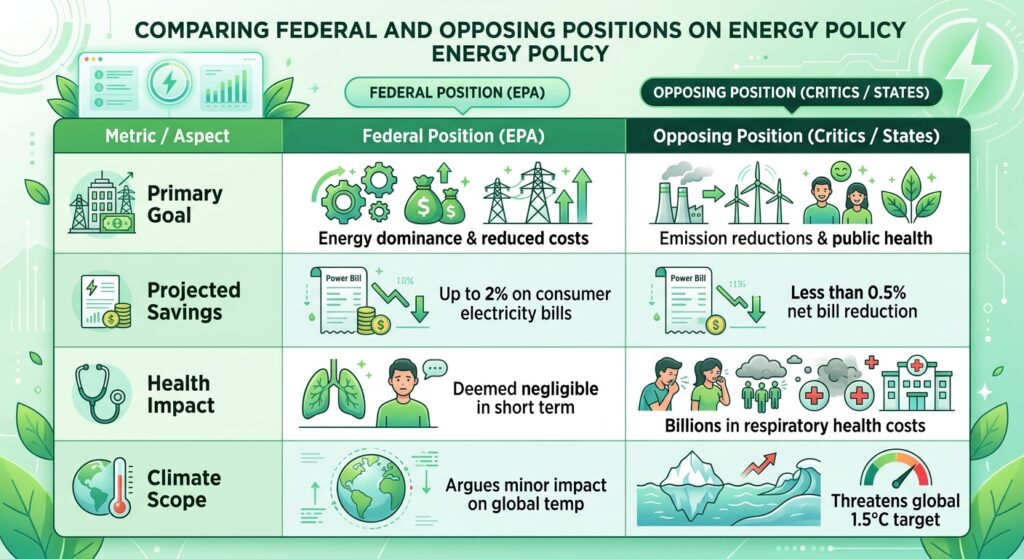
Concurrently, subnational jurisdictions such as California and New York are enforcing local environmental regulations within their borders. This regulatory divergence creates an intricate operational landscape for regional power grids, increasing uncertainty for energy developers and grid operators across state lines.
Supreme court test awaits national energy policy
The dispute is expected to advance to the U.S. Supreme Court, setting up a decisive trial regarding federal executive authority and environmental governance. Should the judiciary uphold the repeal, the country could experience renewed reliance on coal-fired generation, accompanied by worsening regional air quality.
Read also: World Bank, FG Open Joint Mission in Bauchi to Scale $300m ACReSAL Programme
Conversely, a judicial ruling against the agency would reaffirm the regulatory basis for federal decarbonization initiatives. Such a verdict would offer regulatory clarity, helping align national policy with broader international climate commitments.